Issues with Algebraic Manipulation
- Difficult to simplify Boolean expressions
- There is no clear steps in the manipulation process
- Does not always guarantee a minimal expression
- Our goal is to minimize the number of literals
- Literal count is a good measure of cost of logic implementation
- Proportional to # of transistors in the circuit implementation
The Uniting Theorem
- Key tool to simplification:
➢ On-set contains all input combinations when the function is 1
➢ Off-set contains all input combinations when the function is 0
➢ Dc-set contains all input combinations for which the function is X
- Essence of simplification of two-level logic:
- Find two element subsets of the ON-set where only one variable changes its value
- This single varying variable can be eliminated
- Single product term can be used to represent both elements
Karnaugh Maps (K-Maps)
- The K-map is a reorganised graphical representation of a truth table
- The K-map can provide a minimal 2-level SOP or POS implementation
- Used to minimize Boolean equations with 2-4 variables
Its key idea is to place the minterms that differ in only one variable adjacent to one another, so that one can “visualize” opportunities to apply the uniting theorem and eliminate one variable
2-Variable K-Map
- In a 2-variable K-map, one square represents a minterm with 2 variables
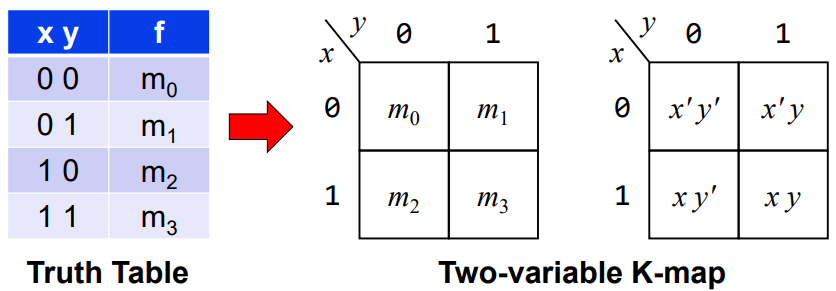
- Each minterm is adjacent to another minterm that differs in only one variable
Example of using the K-map:
- Simplify:
- Two adjacent squares containing 1’s can be combined
- Therefore, can be simplified as:
3-Variable K-Map
- For a 3-input logic circuit, the truth table will have rows represented by 8 squares in the K-map
- Numbering scheme based on Gray–code
- e.g. 00, 01, 11, 10 (be careful!)
- Only one bit changes for adjacent squares
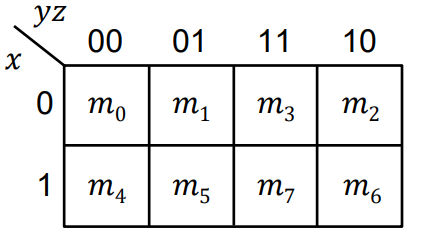
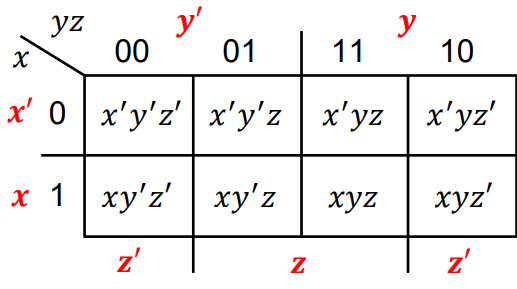
- In a 3-variable K-map, one square represents a minterm with 3 variables
4-Variable K-Map
- For a 4-input logic circuit, the truth table will have rows represented by 16 squares in the K-map
- Otherwise, same as above
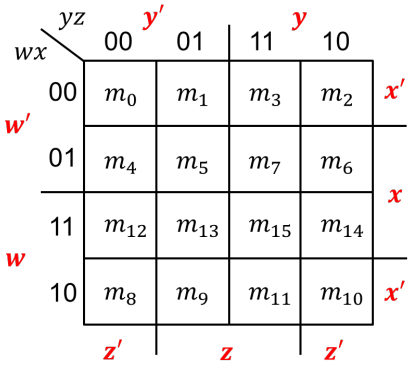
- Squares can be considered adjacent if they are on opposite ends to each other
- e.g. all four corners could be grouped
K-Maps With Don't Cares
- To use a K-map, it is necessary to make an entry in every square
- We can choose the value of “don’t care” states such that they can be used to assist in minimization
- However, once you set the value of such tile it cannot change to a different value for another group
Definitions for Two-Level Simplification
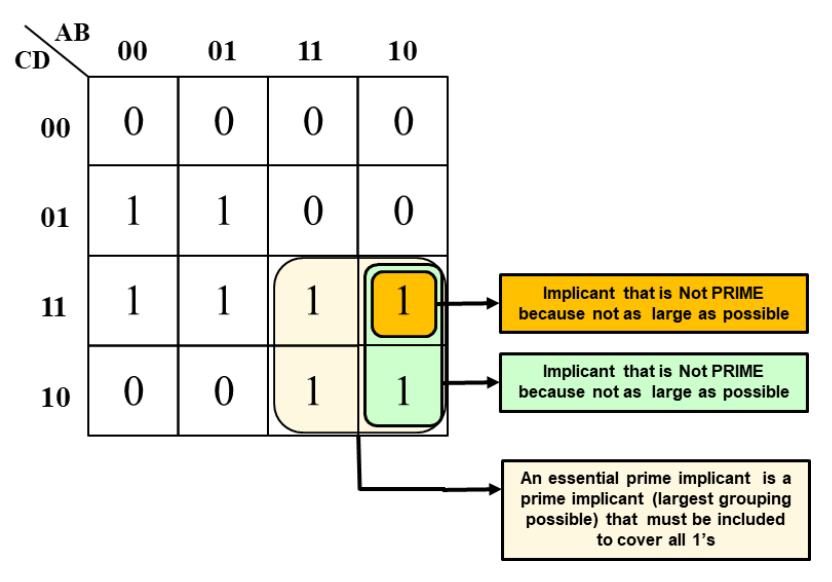
- Implicant a product term that corresponds to a grouping of 1’s
- Can include don’t cares but must include at least one “1”
- Prime Implicant implicant that cannot be completely contained in any other implicant
i.e. the largest possible implicant for a group of 1’s - Essential Prime Implicant a prime implicant which is the only one that covers a group of 1’s
- “Don’t cares” used in prime implicants but do not make implicant essential
- You must use this implicant to cover all 1’s
Product-of-Sums Minimisation
- Apply same techniques as earlier, but group 0s in your K-maps
- Replace all maxterms in grouping by a single expression
- Expression formed by OR of the complement of the variables which do not change throughout grouping
- Thus, all those variables changing in the grouping are eliminated
Both forms of minimisation are viable and should be attempted as one technique may produce more simplified results than the other