ELEC1303 - Lecture 15
Designing Sequential Circuits - Slides
Introduction
- Combinational circuits same inputs always produce same outputs
- No internal memory
- Sequential circuits has memory elements and combinational logic
- Outputs depend on inputs and the current state of memory
Two Types of Sequential Circuits
- Synchronous sequential circuit uses clock signal
- Changes in memory are controlled by clock
- Changes happen at discrete times
- Changes in memory are controlled by clock
- Asynchronous sequential circuit no clock
- Changes in memory can happen any time
We focus on synchronous circuits as they are easier to analyse and design
Sequence Recognisers
- A sequence recogniser is a special sequential circuit that looks for a special bit pattern in some input
- One bit of input supplied on every clock cycle
- Outputs “1” when pattern found

- Circuit needs to remember inputs from previous clock cycles
State Diagram
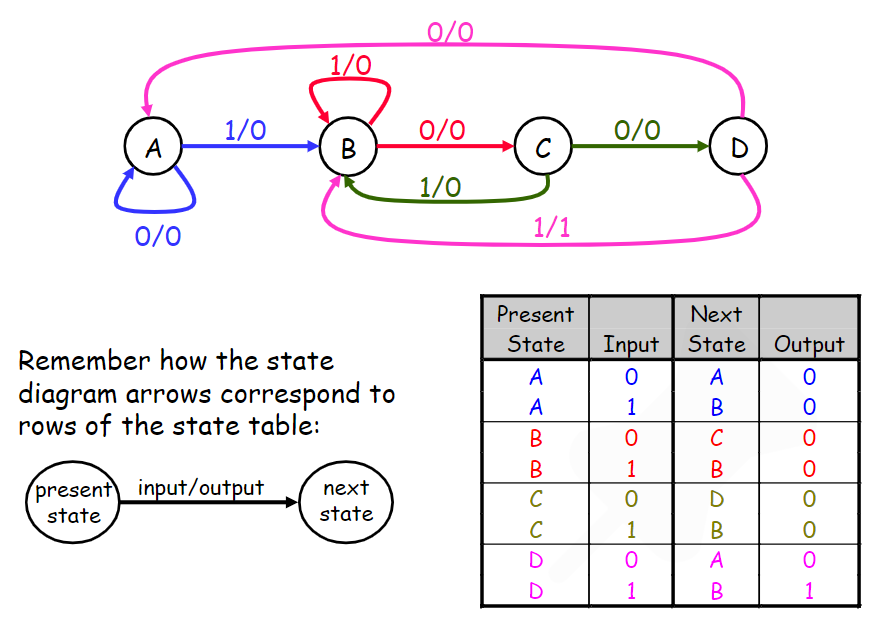
Sequential Circuit Design Procedure
- From our state table, we can assign flip-flop values
e.g. we have four states ABCD, so we need two flip-flops QQ
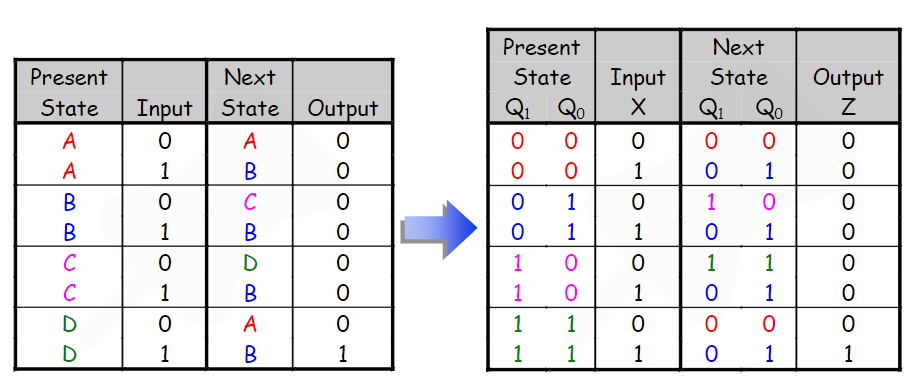
- Then assign flip-flop input values (e.g. D, JK, etc.)
- An excitation table shows what flip-flop inputs are required in order to make a desired change
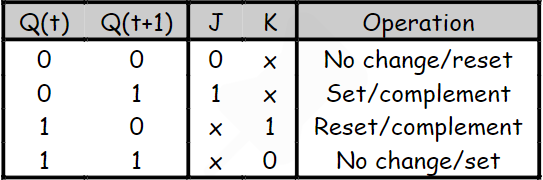
More excitation tables in slides
- An excitation table shows what flip-flop inputs are required in order to make a desired change
Note: for some circuits, you will have unused states in your state table, you can simply fill in the table with don’t cares for the next states
OR, you could fill in the next states to reset to the first state to ensure that if the circuit enters an unused state, it will end up in a valid state
This is known as a self-starting counter