Free vibration is the oscillation of a system disturbed from equilibrium and then left alone with no external forces after .
Summary bq
We typically analyse a single degree of freedom system, such as a particle of mass attached to a spring of stiffness .
A vibration system can also optionally have a damper. This causes energy loss in the system over time and is known as damped free vibration.
Spring Stiffness
Spring stiffness (), also known as the spring constant, is a measure of how stiff a spring is. Its units are Newtons per metre ().
Undamped Free Vibration
The stiffness of a spring creates a restoring force in the opposite direction of an object’s movement, proportional to that object’s displacement:
We measure from the equilibrium position. It is difficult to solve for using the above equation, thus given that physical springs oscillate we make an assumption using an exponential model to solve :
Comment bq
Exponential and trigonometric models can be used for oscillation, however, exponentials are easier to differentiate.
This gives us an equation for . Since from our equation, we can see that is constant for a given system, we call it the natural frequency ().
Since contains imaginary numbers, we convert our assumption into a general real solution using Euler’s formula ():
Definition bq
and are constants that must be determined using the initial conditions of our spring-mass system.
Single-Wave Form & Wave Properties
Our earlier solution can be condensed into one sine wave function:
This is useful if we already know or need to calculate the amplitude () or the phase angle ().
Amplitude ()
Phase Angle ()
Frequency and Period
Angular frequency () can be converted to frequency (Hertz) and period (seconds) using these equations:
We can also obtain max speed and acceleration using amplitude:
- Maximum Speed:
- Maximum Acceleration:
Effect of Gravity
If a spring is oriented vertically, the force of gravity shifts the equilibrium position downward. The stretched resting point is known as the static equilibrium position.
Quote bq
Gravity does not affect the oscillation when measured from the static equilibrium position.
The static deflection () is the length the equilibrium position drops due to gravity. It can be determined using the following equations:
Springs in Parallel
If an object is connected to two or more side-by-side springs, the springs are considered to be in parallel with one another. Parallel springs will stretch (or compress) by the same amount () when the mass moves.
The stiffness of each individual spring can be added together to get the total equivalent stiffness () of the spring system.
Springs in Series
If an object is connected to two or more springs connected end-to-end, the springs are considered to be in series with each other. Springs in series all have the same force () pass through them.
The equivalent stiffness () of the system decreases with each spring added in series, as seen by the equation above.
Energy Method and Equivalent Systems
In an undamped system, energy continually transforms between kinetic energy () and potential energy (), while total energy remains constant.
Using this condition, instead of needing to track vector forces, we can collapse a complex system into a standard vibration equation.
Definition bq
represents linear displacement () or angular displacement () depending on the system. is the generalised acceleration.
There are several main scenarios that can be classified as an undamped system: springs in parallel or series, object rolling without slipping while attached to a spring, an object pivoting about , or springs on lever arms.
Linearisation for Small Oscillations
Exact physical equations often result in non-linear terms (like ). For small oscillations, we apply the small-angle approximations:
This mathematical step is mandatory to collapse the equation into the standard linear harmonic form:
Oscillating Rolling Without Slipping
When an object rolls without slipping, it has both translational kinetic energy () and rotational kinetic energy ().
Comment bq
The no-slip condition is .
With moment of inertia , the total kinetic energy combines to:
Given the standard kinetic energy form (), we get equivalent mass:
Rigid Body Pivoted at a Fixed Point
For a rigid body rotating about a fixed hinge , using the mass moment of inertia reduces the equation of motion to a pendulum form:
Definition bq
is the distance from the pivot to the centre of mass (), and is the radius of gyration about pivot .
From this differential equation we can extract the natural frequency:
Springs on Lever Arms
If a spring is attached along a rotating bar or lever arm (rather than acting directly inline), you cannot just use angle for the spring’s potential energy.
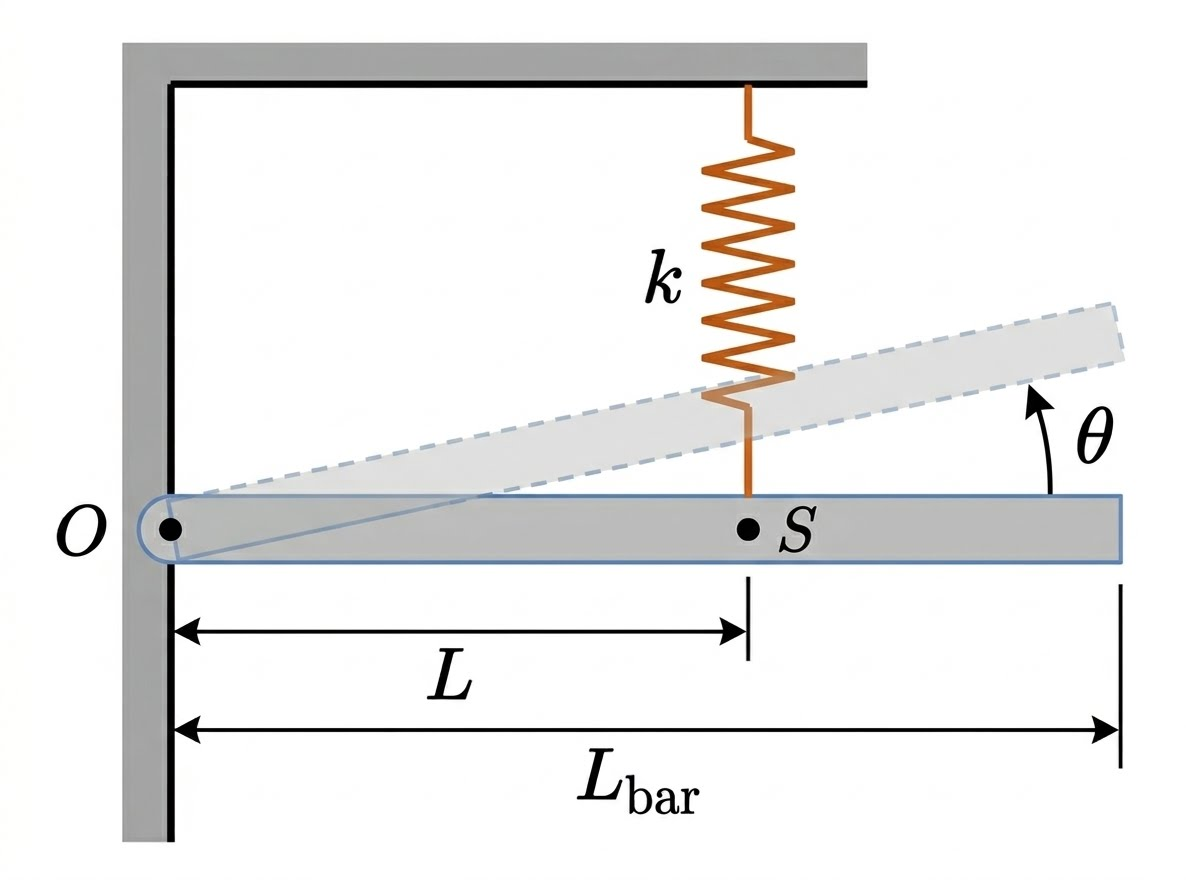
You must write the spring’s Potential Energy () using the actual linear displacement calculated at the spring’s specific attachment point () using geometry such as .
await dv.view("Scripts/topic-backlinks");