Impact is a high force collision between two bodies that occurs over a very short period of time. External forces such as gravity and friction are negligible to the massive internal forces.
Line of Impact
The line of impact is an imaginary line drawn at the point of contact that is perpendicular to the contact plane.
During an impact, provided no external impulses, it can be assumed that the two objects only transfer momentum between each other, meaning their linear momentum is conserved.
Elastic and Inelastic Collisions
A collision is categorised based on how much kinetic energy is saved or lost. The coefficient of restitution () is used as a measure of elasticity:
| Collison Type | |
|---|---|
| Perfectly Elastic | |
| Partially Inelastic | |
| Perfectly Plastic |
Elastic collisions means no energy is wasted and kinetic energy is perfectly conserved. The objects bounce off with maximum velocity.
Inelastic collisions means the objects move together after impact causing the maximum possible loss of kinetic energy.
Central Impact
A central impact occurs when the direction of motion of the two colliding particles are along the line of impact.
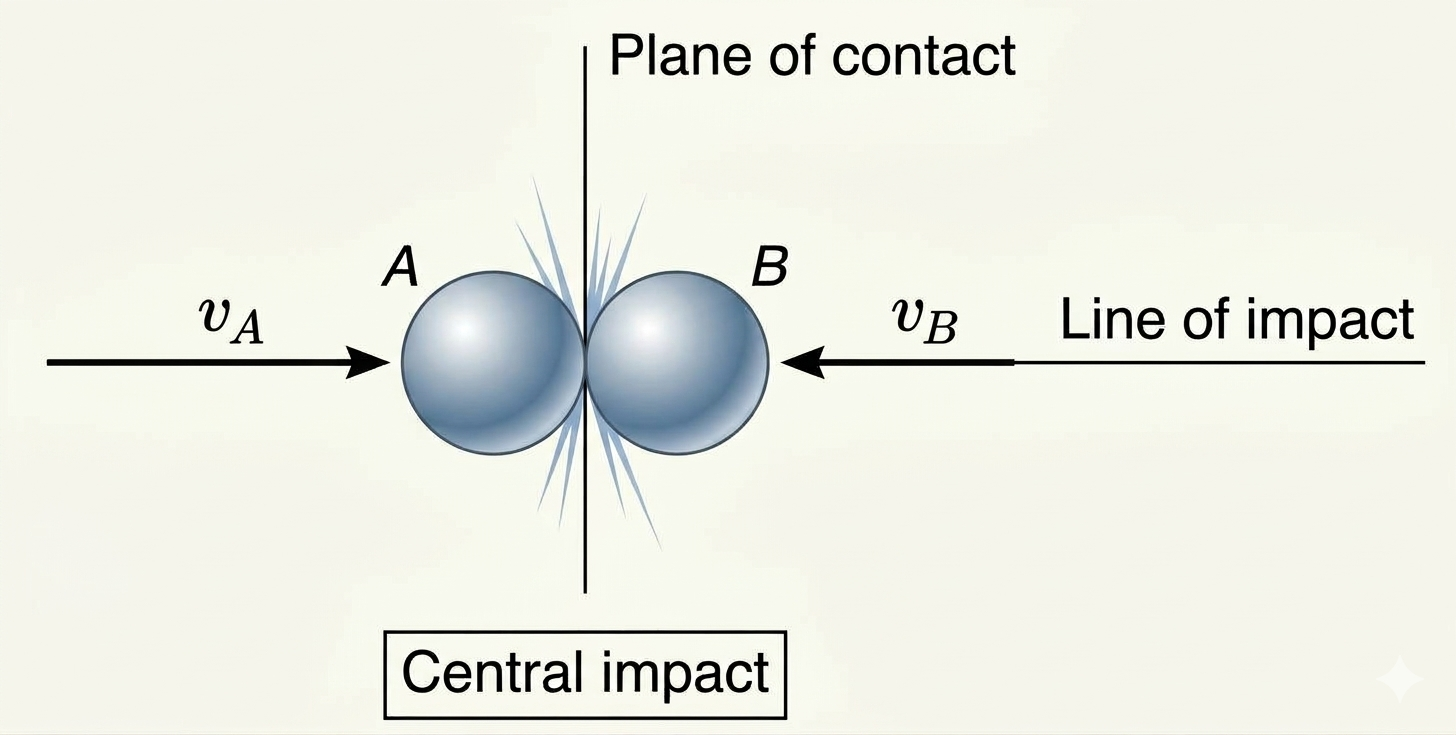
Most collisions are partially inelastic. We can calculate the coefficient of restitution using this formula:
Comment bq
This can be solved by applying conservation of momentum.
We can also calculate energy loss using this formula:
Oblique Impacts
An oblique impact occurs when the direction of motion of one or both of the particles is at an angle to the line of impact.
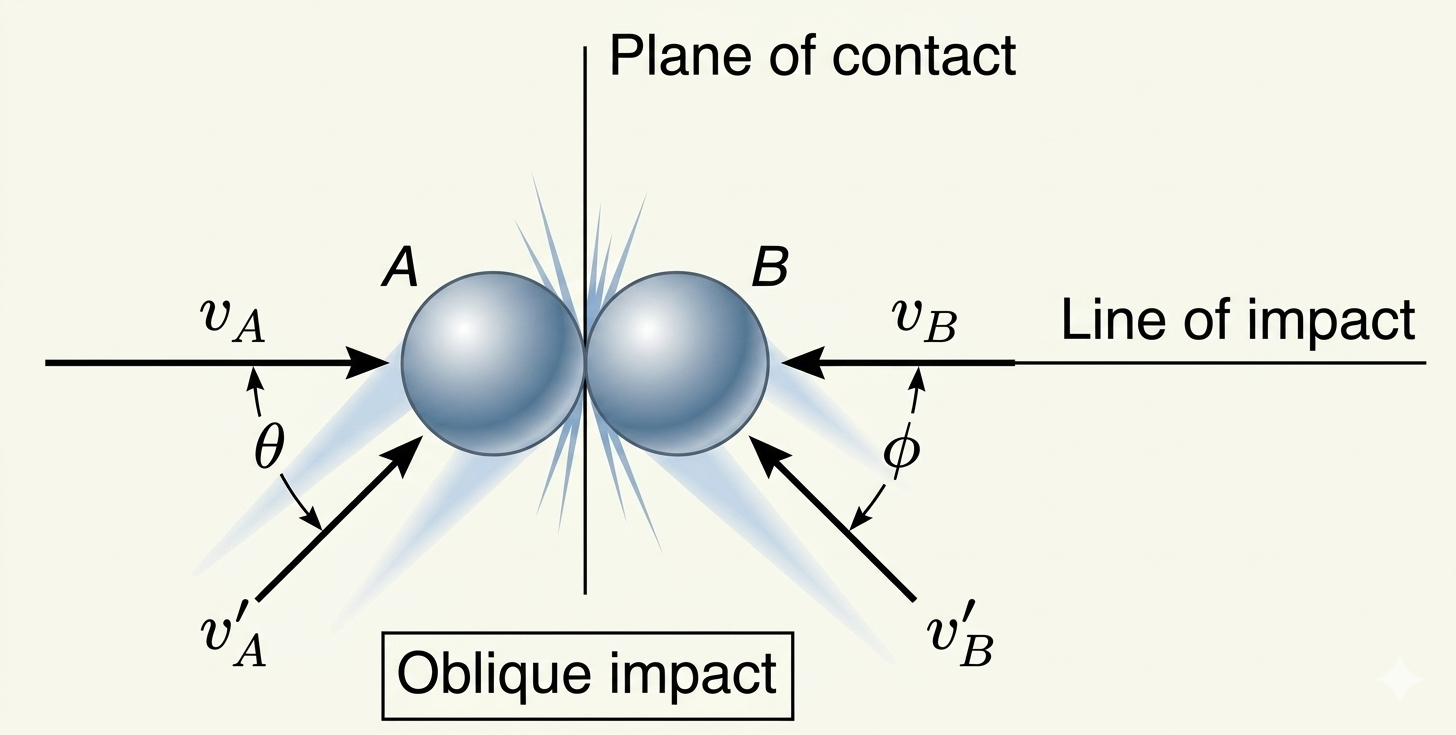
For an oblique impact, we set up a tangential () and normal () axis. In the tangential direction, there is no impulse, therefore each object keeps its tangential velocity before and after the collision.
We use conservation of momentum and as above for the normal components of velocity. Then we can rebuild the final velocity:
Fixed Surfaces
If a moving ball hits a rigid, unmoving wall or floor at an angle, it parallel speed () remains the same, but its perpendicular speed is reduced by the coefficient of restitution:
The rebound angle is given by the following formula:
await dv.view("Scripts/topic-backlinks");