Lower Bound Complexity
- Lower bound complexity is the absolute minimum amount of time/resources an algorithm can take to solve a problem
- Lowest time attainable with a perfectly efficient algorithm
- Denoted with instead of
The lower bound for sorting non-natural/general numbers is:
- @ You cannot make an algorithm faster than this
Merge-sort achieves this level of complexity
- Merge sort has complexity → used instead of when describing the actual complexity of an algorithm
Quick note: Algorithms are typically shown sorting in ascending order, but it only requires a small change for any algorithm to sort in descending order
- ! In terms of increasing time:
Divide-and-Conquer
Before we explore merge-sort:
- Divide-and-conquer is a general algorithm design paradigm
- Paradigm → pattern or model
Divide-and-conquer is split into three parts:
- Divide → divide input data into two disjoint subsets and
- Disjoint → no elements shared between sets
- Recur → solve subproblems associated with and
- Conquer → combine solutions for and into solution for
Merge-sort is based on the divide-and-conquer paradigm
Merge-Sort
Takes input sequence with elements:
- Divide: partition into two sequences and of elements each
- Recur: recursively sort and
- Conquer: merge and into a unique sorted sequence
Example of a Python merge and merge-sort algorithm:
def merge(S1, S2, S): # merge two sorted Python lists
    i = j = 0
    while i + j < len(S):
        if j == len(S2) or (i < len(S1) and S1[i] < S2[j]):
            S[i + j] = S1[i]   # copy ith element of S1
            i += 1
        else:
            S[i + j] = S2[j]   # copy jth element of S2
            j += 1

def merge_sort(S): #sort list using merge-sort algorithm
    n = len(S)
    if n < 2:
        return  # list is already sorted

    # divide
    mid = n // 2
    S1 = S[0:mid]   # first half
    S2 = S[mid:n]   # second half

    # conquer (recursion)
    merge_sort(S1)
    merge_sort(S2)

    # merge results
    merge(S1, S2, S)
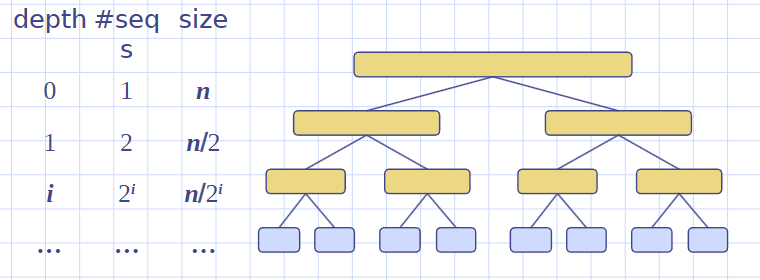
Analysis of Merge-Sort:
- The height of the merge-sort tree is
- Each split divides size by 2:
- Overall work done at the nodes of depth is
- At depth , there are subarrays of size →
- Thus, total run time of merge-sort is
In algorithms, always means → which is the standard