MATH1012 - Lecture 28
Wk10 Skeleton Slides
Wk11 Skeleton Slides
Nonhomogeneous, Constant Coefficient
- To solve the 2nd order linear DE with constant coefficients: (
- Find solution of associated homogeneous DE
- Called the complementary function
- Then find any particular solution of the original nonhomogeneous differential equation
- See below
- The general solution of the nonhomogeneous differential equation is
- Find solution of associated homogeneous DE
Method of Undetermined Coefficients
There is an easy way to find if is in a certain form:
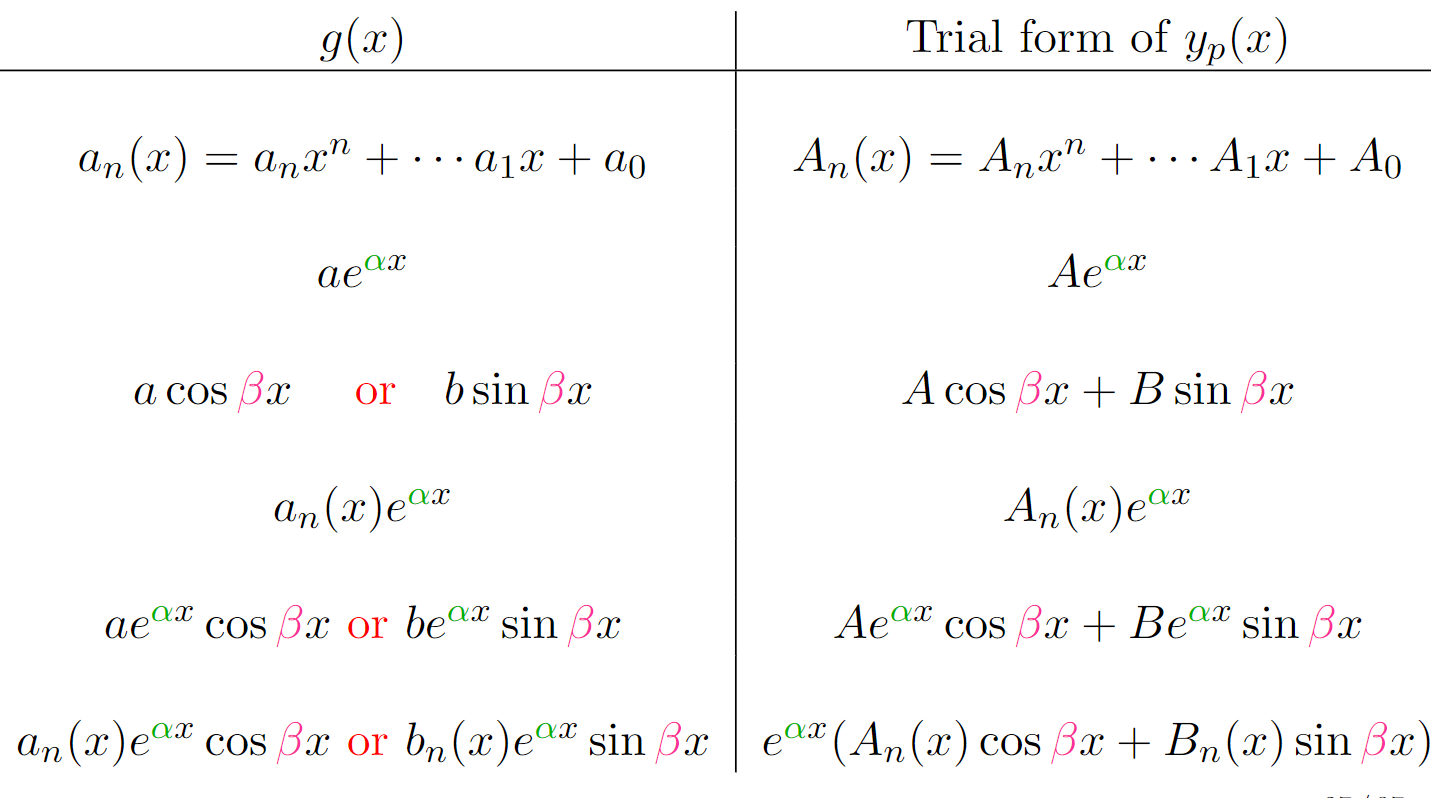
- If is the sum of different expressions in the left column of the table then can be taken as the sum of the corresponding solutions
- Solve by substituting it into the original DE
One Thing to Watch Out For
If has a term which appears in the complementary function () then the suggested guess won’t work. We should multiply our original guess by and try again.
What About Other Right-Hand Sides?
- If isn’t in our table, we can use variation of parameters
- e.g. ,
- This method is in the Unit Reader but is not examinable
Affine Spaces
- An affine space is a translated vector space
- The order inhomogeneous differential equation will have a general solution that is an affine function space
- This content is not examinible
Laplace Transforms
- Let be defined for all , the Laplace transform () of is:
- i.e.
- It is an improper integral that must be convergent for a solution
- We use the notation:
- or just for
- is the variable for and is the variable for
- If is the Laplace transform of , then is the inverse Laplace transform () of
- There is no formula to compute the inverse Laplace transform
- Instead we refer to a table of Laplace transforms