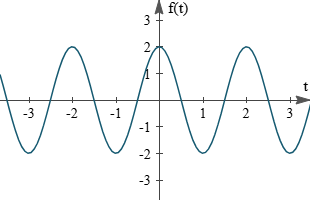
If f(t) is an even function with period 2L, then: a0=L1∫−LLeven functionf(t)dt=L2∫0Lf(t)dt an=L1∫−LLeven functionf(t)cos(Lnπt)dt=L2∫0Lf(t)cos(Lnπt)dt
\underbrace{f(t) \sin\left(\frac{n\pi t}{L}\right)}_{\text{{\emph{odd function}}}} \, dt = 0$$
### Fourier Sine Series for Odd Functions
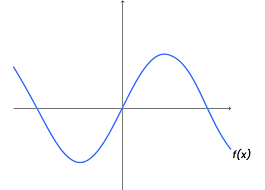
- If $f (t)$ is an <font color="#00ff52">odd function</font> with period $2L$, then:
$$a_0 = \frac{1}{L} \int_{-L}^{L} \underbrace{f(t)}_{\text{{\emph{odd function}}}} \, dt = 0$$
$$a_n = \frac{1}{L} \int_{-L}^{L} \underbrace{f(t) \cos\left(\frac{n\pi t}{L}\right)}_{\text{{\emph{odd function}}}} \, dt = 0$$
$$b_n = \frac{1}{L} \int_{-L}^{L}
\underbrace{f(t) \sin\left(\frac{n\pi t}{L}\right)}_{\text{{\emph{even function}}}} \, dt = \frac{2}{L} \int_0^L f(t) \sin(\frac{n\pi t}{L})\, dt$$
### Half-Range Expansions
- Let $f(t)$ be defined on $[0, L]$
- An expansion of $f(t)$ to $[-L, L]$ is called a *half-range expansion*
- We can observe two separate forms for odd and even functions:
- <font color="#f38ba8">Even half-range expansion:</font> $g(t) = \begin{cases} f(t), & \text{if } 0 \leq t \leq L \\ f(-t), & \text{if } -L \leq t \leq 0 \end{cases}$
- <font color="#a6e3a1">Odd half-range expansion:</font> $h(t) = \begin{cases} f(t), & \text{if } 0 < t < L \\ 0, & \text{if } t = 0 \\ -f(-t), & \text{if } -L < t < 0 \end{cases}$
- Even functions are always continuous!
---
> [[MATH1012 - Week 9 (Annotated).pdf|Annotated Slides]]