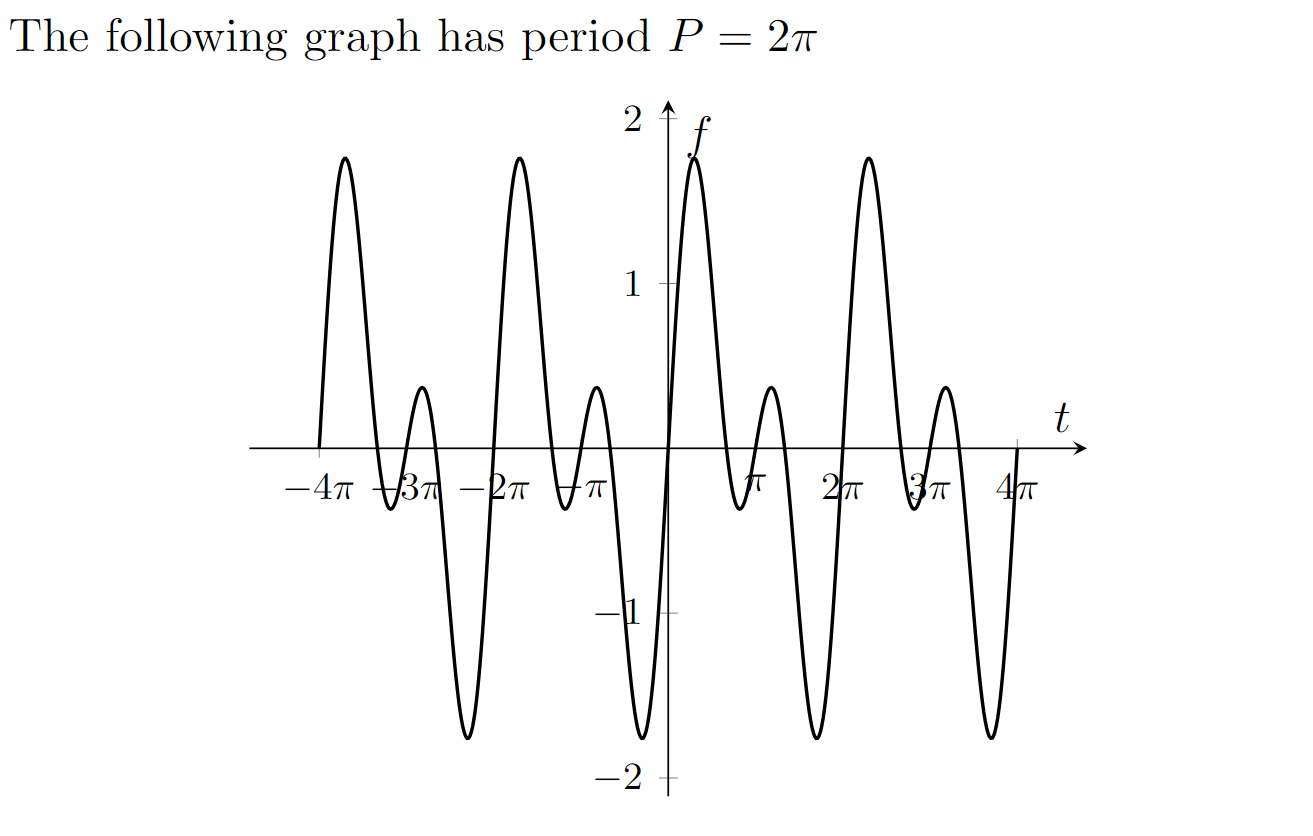
A function is periodic with period P if, for all t: f(t+P)=f(t)
Example:
Many naturally occurring waveforms are periodic
We want to express any given 2π-periodic function f as being a linear combination of: 1,cost,cos2t,cos3t,⋯,sint,sin2t,sin3t,⋯
The Fourier series expansion of f(t) is a series in the form: $$
\text{FS}{f(t)} = \frac{a_0}{2} + \sum{n=1}^{\infty} a_n \cos nt + \sum_{n=1}^{\infty} b_n \sin nt
- The numbers $\{a_n\}^\infty_{n=1}$ and $\{b_n\}^\infty_{n=1}$ are Fourier coefficients
- For periodic cases, Fourier series is <u>more useful</u> than a power series
> Start with a (measured, observed) periodic function $f$, and then:
> ⭐ Determine the Fourier coefficients
> ⭐Ensure that the Fourier series converges
> ⭐Use the Fourier series to analyse $f$
### Euler's Formulas for $2\pi$-Periodic Functions
- <font color="#ffff00">Assumes a period of</font> $\textcolor{#ffff00}{2\pi}$, watch lecture recording ig
$$\text{FS}_{f(t)} = \frac{a_0}{2} + \sum_{n=1}^{\infty} a_n \cos nt + \sum_{n=1}^{\infty} b_n \sin nt$$
$$a_0 = \frac{1}{\pi} \int_{-\pi}^{\pi} f(t) \, dt$$
$$a_n = \frac{1}{\pi} \int_{-\pi}^{\pi} f(t) \cos(nt) \, dt$$
$$b_n = \frac{1}{\pi} \int_{-\pi}^{\pi} f(t) \sin(nt) \, dt$$
> Read [[MATH1012 - Week 9.pdf#page=9|slides]] on how to find other coefficients ($n$ and $m$)
### Integration By Parts
$$\int_a^b u'(t)v(t)\,dt = \left[ u(t)v(t) \right]_a^b - \int_a^b u(t)v'(t)\,dt$$
- This formula is helpful when the 2nd integral is easier than the initial
### Periodic Extension
- A function only defined over $[-L, L)$ can be extended periodically
- This is known as *periodic extension*:
![[PeriodicExtension.png|500]]
- For a function $f(t) = t$ extended periodically with period $-\pi \leq t < \pi$:
- $a_0 = \frac{1}{\pi} \int_{-\pi}^{\pi} t \, dt$
- $a_n = \frac{1}{\pi} \int_{-\pi}^{\pi} t \cos(nt) \, dt$
- $b_n = \frac{1}{\pi} \int_{-\pi}^{\pi} t \sin(nt) \, dt$
---
> [[MATH1012 - Lecture 25]]
> [[MATH1012 - Week 9 (Annotated).pdf|Annotated Slides]]