Introduction
- A (real) vector is an ordered -tuple of real numbers
- A vector is the coordinates of points in -dimensional space
- The set of all vectors of arity is denoted
Preliminary Knowledge:
💫 Vectors Y11
💫 Vectors Y12
💫 Functions
The Vector Space
is the standard plane, is 3D space
But we can go beyond that into spaces we can’t visualise geometrically
- Vectors can only be added with vectors with the same arity
- e.g. you cannot multiply a 2D and 3D vector
Vector-Valued Functions
A vector-valued function is a function that takes a real number and assigns a vector in
refers to the number of dimensions
Curve in 3D
We say that for , are parametric equations of with parameter , or equivalently, that is a parametrisation of
- We can use parametrisation to describe curves that cannot be defined with a single function
Skills to Learn
You must be able to convert between parametrial equations into an equation with a relationship between and (and ) allowing you to sketch curves/shapes in 2D/3D space.
Functions of Two Variables
- A function of two variables is a rule that assigns to each a real number
- Converts a vector into a real number
Level Curves
-
Gives visual information about a surface (read graphing functions of two variables on slides) in a 2D form
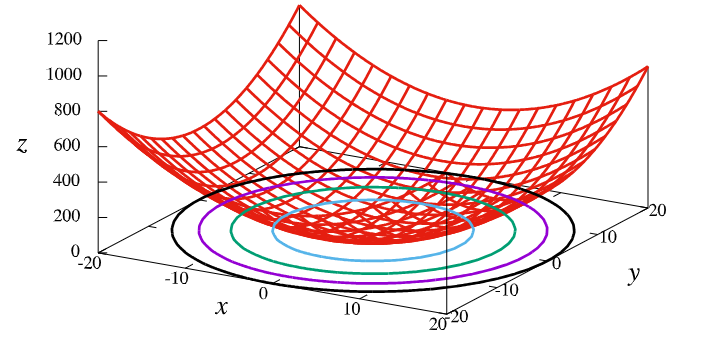
- Level curves are traditionally found in maps in order to inform the reader on the shape of the terrain
-
Imagine a horizontal plane cutting through the surface
- is some real constant (in the range of ) that defines a curve in called a level curve of
- The level curve is created where the surface intersects the plane
-
When asked to sketch level curves, decide an integer constant to be the difference between each level of
- e.g.
Level Surfaces
- Just as we can represent a 3D shape in 2D with level curves, we can represent a 4D shape, one that normally cannot be represented geometrically, in 3D, through level surfaces