Introduction
- For a refresher on limits of scalar-valued functions, watch lecture recording 2
Limit Laws
- For any constant
- If , then
Need to practice applying and using limit laws
One-Sided Limits
- For some functions, approaching from either side would produce a different limit
- In this scenario, there is no true limit, however, there is a special notation to write a limit for either side
- We write:
- if gets close to as gets close to with
- if gets close to as gets close to with
- only exists if the limits from both sides exist and are equal
Limit Taking Techniques
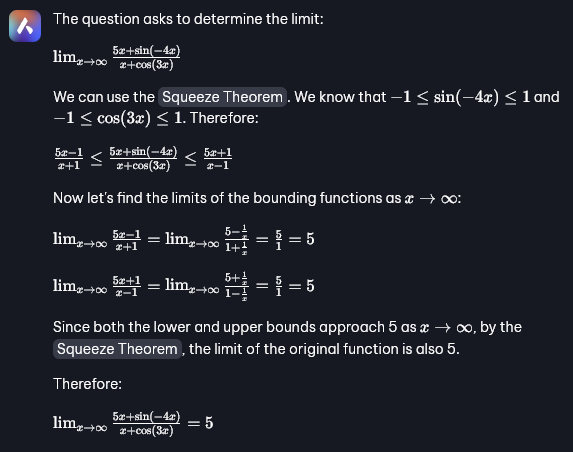
Squeeze Theorem
Read about Squeeze Theorem on slides
Useful for proving the limit of an oscillating function (e.g. a trigonometric function)
-
Worked Example:
Diverging to
- Whenever a function approaches as , we consider that the limit does not exist
- It can still be denoted as or
L’Hospital’s Rule
- Watch lecture recording or read slides
Polar Coordinates
- corresponds
- Where
Limits of Vector-Valued Functions
- Limit of exists if the limit of and exist
- ()
Bolded variables represent vectors
e.g. could mean
Continuity of Functions
- A function is continuous if its graph has no graphs
- This is represented mathematically by:
i.e. f is continuous at c
Combining Continuous Functions
- The functions and are continuous at
- If , then is continuous at
- If is a function of a single variable , defined on the range of and continuous at , then is continuous at
- If , and is a vector-valued function such that for and , and if is continuous at , then the function is continuous at