Maxima and Minima
- Review: Types of Stationary Points
- Apply your Year 11 differentiation techniques to find absolute and local extrema
- e.g. 2nd derivative, critical points, etc.
- Remember for a function defined over an interval to check the value of at both ends of the interval; they may be the absolute max/min
Maxima and Minima of Vector-Valued Functions
- A critical point of a vector-valued function occurs at any point where or does not exist
- See: The Gradient
Saddle Point
- A critical point of is called a saddle point if has neither a local minimum nor a local maximum at the point
Boundary
- The boundary of a function are the ‘edges’ of a function
-
i.e. the boundary of a subset is the set of all points such that every open disc centred at on the boundary contains points inside and outside the domain
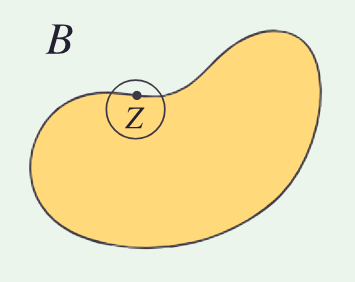
-
The boundary is a subset of the domain
-
Boundary Cont.
- A subset is called closed if all its boundary points are in the subset, that is, if
- A subset is called open if none of its boundary points are in the subset, that is, if
- A set is called bounded if it is contained in a disc of finite radius
- Open and closed refer to
- Bounded and unbounded refer to
Extreme-Value Theorem
- For a function over that is a non-empty, closed and bounded subset and the function is a continuous function, there is an absolute maximum and minimum on