Partial Derivatives
- A function can be partially derived by only deriving one value
- e.g. for , the partial derivative of with respect to is written as
- is considered a constant
- Cannot use ; must show which variable is being derived
- e.g. for , the partial derivative of with respect to is written as
- can be used for the partial derivative of with respect to
- In this case, is treated as a constant
Geometric Interpretation
- At a given point, the value of = slope of the tangent line to the surface that is parallel to the −plane
- At a given point, the value of = slope of the tangent line to the surface that is parallel to the −plane
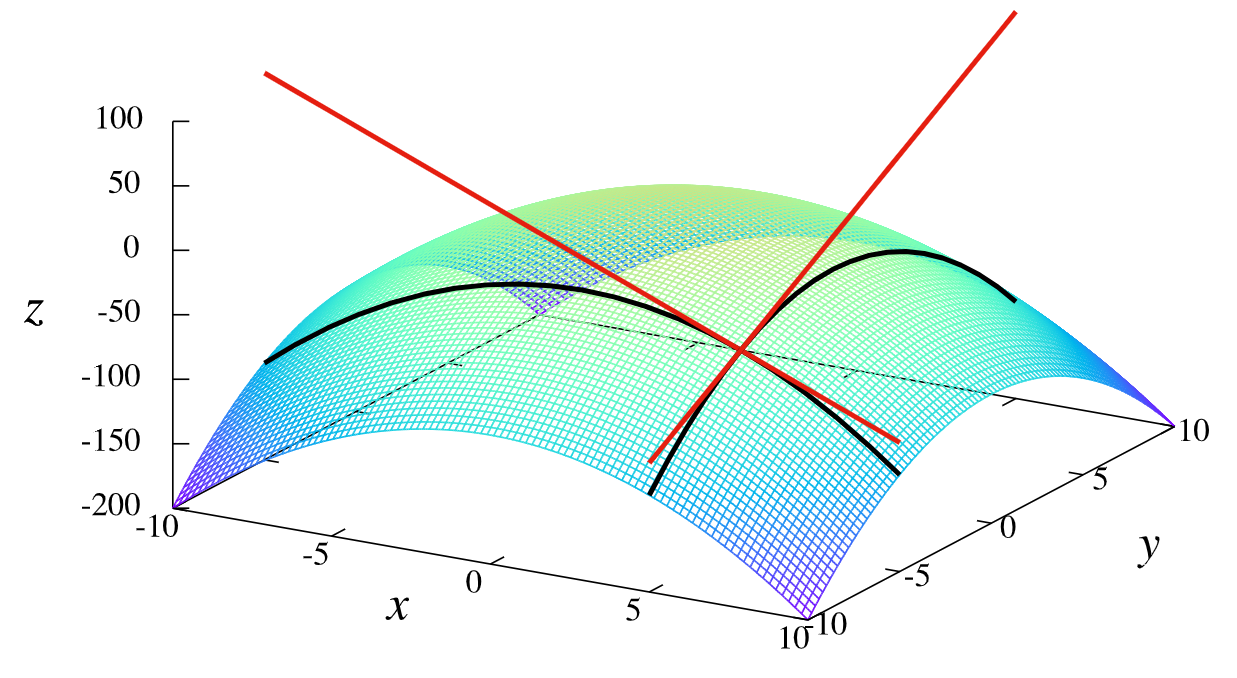
- i.e. the two tangent vectors at a point are
Higher Derivatives
- Read Slides
- Certain notation for higher derivatives
- Dependent on the order of the partial derivative
- Certain notation for higher derivatives
- The order of the partial derivative can matter
- may not equal
Clairaut’s Theorem
- Let be defined on an open disc of
- If the mixed derivative functions and are both defined and continuous on , then on
Tangent Planes
-
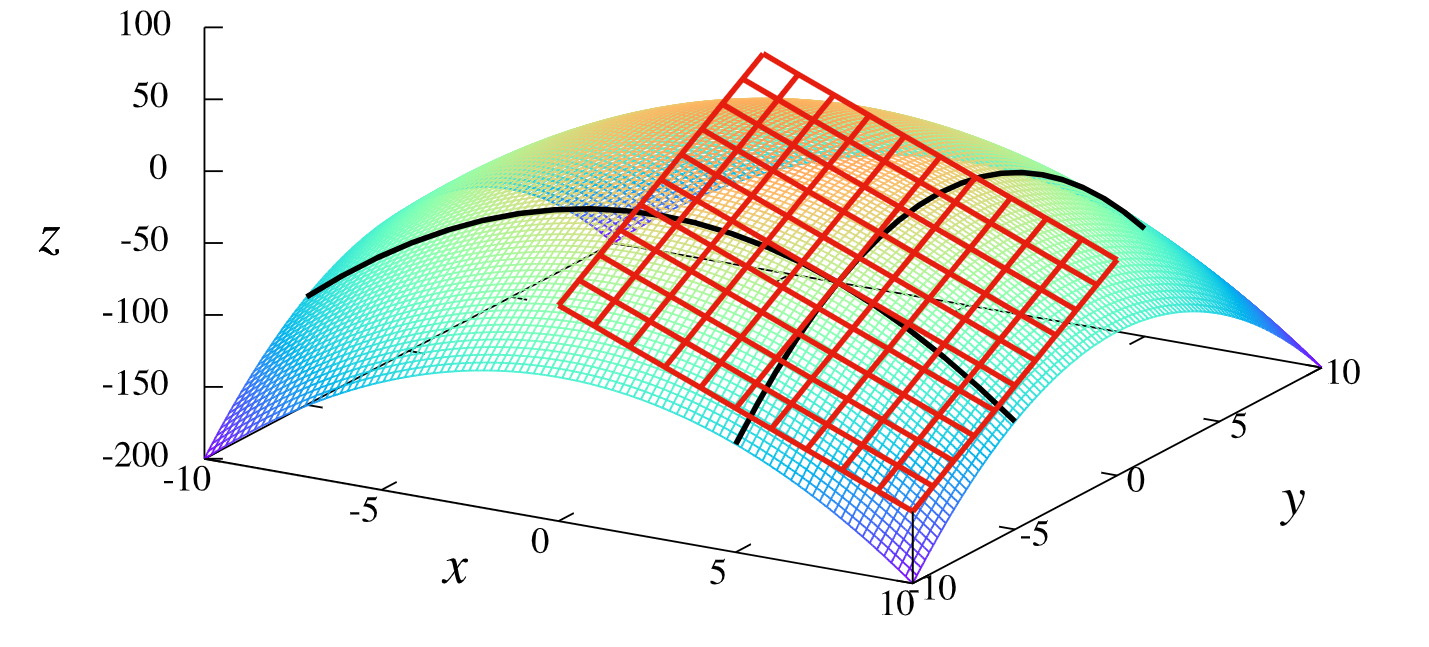
In 3D space, the tangent to a point on a plane is another plane
-
A plane can be constructed using the two tangent lines produced by the partial derivatives, and , which are parallel to the tangent plane
-
See Planes for more information:
- Cross product of two parallel lines in the plane gives the normal
- i.e. the normal at a point is equal to
- Plug into: and use the tangent point for
- Cross product of two parallel lines in the plane gives the normal
-
Alternative formula:
- Tangent plan at the point
- Typically written as
- Or:
- Where is some constant
-
For a surface , the tangent plane at a point :