Be able to convert between parametrial equations into an equation with a relationship between and (and ) allowing you to sketch curves/shapes in 2D/3D space.
Functions of Two Variables
- A function of two variables is a rule that assigns to each a real number
- Converts a vector into a real number
Level Curves
-
Gives visual information about a surface (read graphing functions of two variables on slides) in a 2D form
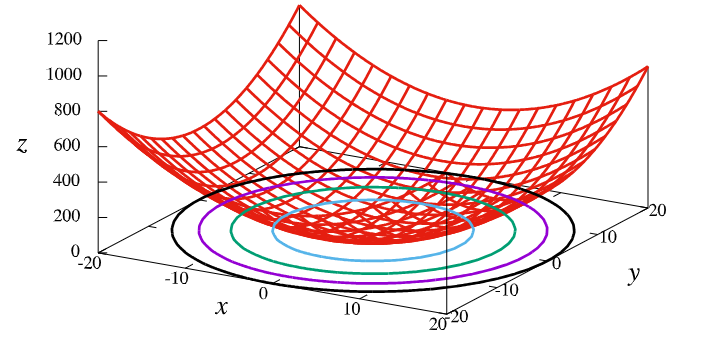
- Level curves are traditionally found in maps in order to inform the reader on the shape of the terrain
-
Imagine a horizontal plane cutting through the surface
- is some real constant (in the range of ) that defines a curve in called a level curve of
- The level curve is created where the surface intersects the plane
-
When asked to sketch level curves, decide an integer constant to be the difference between each level of
- e.g.
Level Surfaces
- Just as we can represent a 3D shape in 2D with level curves, we can represent a 4D shape, one that normally cannot be represented geometrically, in 3D, through level surfaces
End of Chapter 1
Limits and Continuity: Slides
Limits of Scalar-Valued Functions
- For a refresher on limits of scalar-valued functions, watch lecture recording
One-Sided Limits
- For some functions, approaching from either side would produce a different limit
- In this scenario, there is no true limit, however, there is a special notation to write a limit for either side
- We write:
- if gets close to as gets close to with
- if gets close to as gets close to with
- only exists if the limits from both sides exist and are equal
Limit Laws
- For any constant
- If , then
Need to practice applying and using limit laws
Squeeze Theorem
Read about Squeeze Theorem on slides
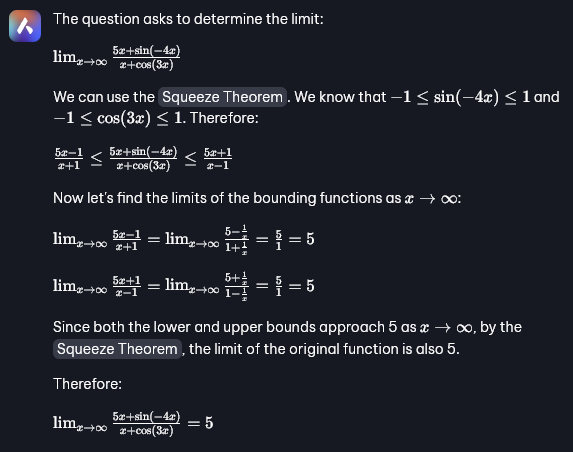
Useful for proving the limit of an oscillating function (e.g. a trigonometric function)
-
Worked Example:
Diverging to
- Whenever a function approaches as , we consider that the limit does not exist
- It can still be denoted as or
L’Hospital’s Rule
- Watch lecture recording or read slides
Limits of Vector-Valued Functions
- Limit of exists if the limit of and exist
- ()
Bolded variables represent vectors
e.g. could mean