Overview
Stakeholder Analysis
- Stakeholders:
- State and Federal Government
- City of Wanneroo (Local Government)
- Private wind energy developers
- Investors
- Local community
- Lagoon Future Community Advisory Group
- Whadjuk Noongar Community
- Environmental Protection Authority (EPA WA)
- Western Australian Planning Commission (WAPC)
- Western Power and other related utilities
- General WA Public
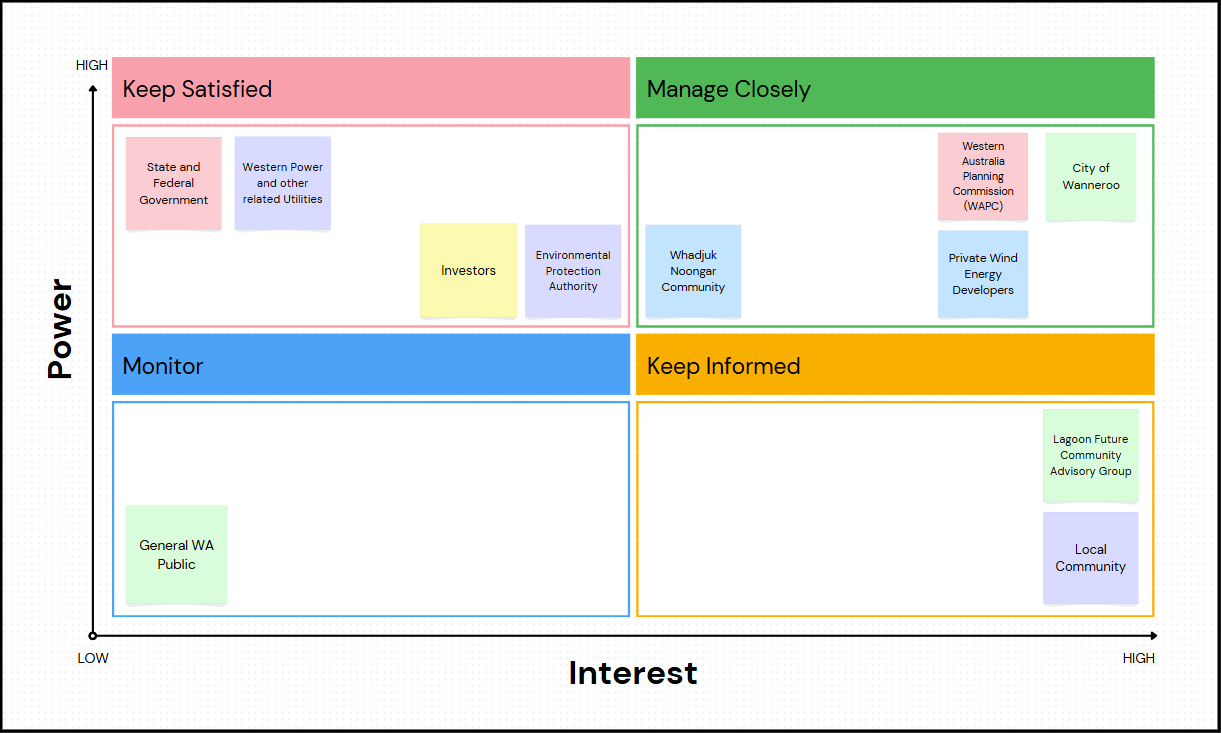
- Stakeholder Map V1:
Analysis of Stakeholder Mapping
The proposed offshore wind farm project will require the coordination and effort of many different parties in order to ensure its success. The most important stakeholders in the project possess a high level of power and interest. These key stakeholders include the City of Wanneroo, the Western Australia Planning Commission (WAPC), private wind energy developers and the Whadjuk Noongar community.
The City of Wanneroo and WAPC are central local authorities and are responsible for planning approvals and infrastructure coordination. Additionally, the City of Wanneroo has already set out plans outlining the development of Yanchep’s coastal infrastructure and thus will be heavily involved with this project. They will be supporting this project as part of creating Yanchep’s future.
Private wind energy developers will also be critical for this project’s success as they will be responsible for delivering the project and ensuring its technical and financial viability. Western Power will also be an important stakeholder, due to their role in integrating the new wind farm into the existing electricity grid.
The State and Federal government are also important stakeholders despite their low interest as they have very high influence over the project as governing bodies. Their roles in policy-making, regulatory approvals and environmental assessments will have a lot of control over the project and it is essential that the project meets the rules and regulations set. The Environmental Protection Authority (EPA) also sets guidelines that must be followed during development.
Finally, the Whadjuk Noongar community, as traditional owners of the land, hold significant legal and cultural interest, requiring meaningful engagement and potential consent under Native Title laws, which recognise Aboriginal and Torres Strait Islander people’s rights and interests surrounding the land and water.
These stakeholders must be actively managed and engaged throughout the project lifecycle to ensure successful outcomes and regulatory compliance.
Some drawbacks of using this stakeholder map to analyse the relationship of the stakeholders of the project include the its static nature. A stakeholder map does not account for how stakeholder power and interest can change over time. As the project undergoes development, it is likely that we will see a shift in different parties involvement, for example, an increase in public interest in response to environmental concerns. Thus a stakeholder map is only useful as a preliminary analysis in the early stages of the project and can lose reliability as the project progresses.
Engineering Process for Yanchep Offshore Project
You find yourself working as an engineer for this offshore wind farm project and have been given the task of planning and executing the cutting of the trench through the reef next to Yanchep Lagoon. What would you do in this situation and why? (Word limit: 1000 words).
As an engineer assigned to the offshore wind farm project, it is essential that I utilise the engineering design process throughout my work on cutting the cable route through the reef. This will allow me to gain a clear understanding of the project, of the issues I need to be aware of and the factors I need to consider in order for me to deliver the task smoothly.
We begin by defining the issue. Our goal is to create a trench through the reef that will have the final cable route pass through to connect the proposed offshore wind farm to the onshore power grid. This area is a very popular swimming and snorkelling spot and also supports a delicate ecosystem composed of a variety of marine life [1]. Throughout this project, we must ensure that we minimise any damage to the local ecosystem and the greater area to meet the significant environmental, regulatory, and social constraints. Damage to the area would cause major backlash from the local and Whadjuk Noongar community, the EPA and other bodies.
Moving on, we must compile background information about the location and research some potential methods for excavation with minimal environmental impact. We would need detailed environmental and geotechnical information about the reef in order to make predictions about the impact our development could have on the landscape and prevent an oversight causing unwanted destruction. This will also help us assess the feasibility of various trenching methods. During this stage, it is also important to outline all the relevant environmental regulations we need to follow set by the government and other agencies, particularly those related to marine conservation and reef protection such as the Environment Protection and Biodiversity Conservation Act 1999 (EPBC Act) [2]. Our stakeholder analysis also has revealed that we need to engage with local environmental agencies and the Whadjuk Noongar people whose insights and concerns could guide our decision making [3].
We now need to consider the different methods we will potentially use for the reef trenching. There are several technical options available for trenching in shallow marine environments, especially those with ecological sensitivity. The most direct method, mechanical trenching through the reef, poses a high risk of irreparable damage to coral and marine habitats [4]. Thus, this method is not favourable and we should seek to find a better alternative. Another approach would be jet trenching, which uses high-pressure water jets to fluidize the seabed material, a commonly used method for creating cable pipelines. This method may have reduced mechanical impact but still stirs up sediments and disrupts marine life [5].
A more environmentally responsible option is horizontal directional drilling (HDD) where a borehole is drilled from shore beneath the reef and exits on the seaward side. This trenchless, environmentally friendly method would avoid direct contact with the reef, preserving its structural integrity and minimizing ecological damage [6]. Though HDD is more costly and technically complex than our other options, its benefits outweigh the cost with how important it is that we maintain the conservation of Yanchep lagoon. Thus I believe that this should be our first choice for the project.
With a preferred solution chosen, we will move onto development and prototyping stage where we must ensure this method’s feasibility. Here, we would create designs for the HDD route and move on to outlining each step of the process. We would also need to be prepared for any potential challenges such as drilling fluid returns and pressure loss [7]. If possible, running simulations or smaller pilot tests could help us confirm that this process would run as desired and give confidence to our stakeholders. We would also need to develop an Environmental Management Plans (EMPs) [8] that outlines mitigation measures, monitoring programs, and emergency response procedures [9]. This plan would be submitted for environmental approval and would ensure continuous and transparent communication with key stakeholders.
Finally, we would move forward with implementing the project. I would contract experienced marine contractors to execute the HDD process after approval from the EPA and government. We would need many different skilled workers to help with implementation, for example, marine ecologists would be present on-site to oversee compliance with protection protocols, particularly during critical operations near the reef.
During development, intense monitoring will be important to ensure that the project is progressing smoothly and so that we can react to any unexpected issues. If any adverse effects are observed, work would be paused and mitigation steps immediately deployed. Environmental conservation and safety would be prioritized throughout this phase, as the success of the project is dependent on maintaining the ecological health of Yanchep Lagoon. It would be much better to stop progress if the risk is too high than to risk causing irreparable damage which could lead to larger social consequences.
References
- https://www.westernaustralia.com/au/attraction/yanchep-lagoon/5e6b40c87a82947726760112
- https://www.dcceew.gov.au/environment/epbc
- https://inherit.dplh.wa.gov.au/public/inventory/printsinglerecord/ef25dd02-2bea-4588-93e9-8ab5619348bd
- https://www.epa.wa.gov.au/sites/default/files/Policies_and_Guidance/Technical%20Guidance%20-%20EIA%20of%20Dredging%20Proposals-131216.pdf
- https://oes.net.au/optc_pipelines.shtml#:~:text=Jetting%20is%20a%20term%20used,stabilised%20by%20a%20lead%20keel
- https://vsl.com/home/build/industrial-energy-producing-structures/wind-towers/horizontal-directional-drilling/?utm_source=chatgpt.com
- https://heavyequipmentcollege.edu/overcoming-challenges-in-horizontal-directional-drilling/
- https://www.wa.gov.au/organisation/department-of-water-and-environmental-regulation
- https://www.epa.wa.gov.au/forms-templates/instructions-part-iv-environmental-management-plans