ENSC1004 - Lecture 1
Introduction to Engineering Materials - Slides
Classification of Materials
- There are so many materials in the modern age that we need to classify them based on their properties
- Engineering materials are classified based on the nature of their interatomic bonding
- Three engineering material classes:
- Metals
- Polymers
- Ceramics
- bonus class; Composites
- Composites are made of a combination of the other types
- Types of Interatomic Bonding:
- Metallic bonding formed by metallic elements
- Ionic bonding formed between metal and non-metal element/s
- Covalent bonding formed by non-metallic elements
Properties of Each Material Class
> Metals:
- Primary bonding: mostly metallic, although not exclusively
- Made of metals
> Ceramics:
- Primary bonding: from ionic to covalent
- Made of metals and non-metals
> Polymers:
- Primary bonding: covalent
- Between molecules: van der Waals (dispersion forces)
- Made up mostly of non-metals
The classification of materials is not unique, this is a basic way to classify materials but there are other ways, such as classifying material based on thermal properties or function.
Properties of Materials
- Intrinsic properties that are already intrinsic to a material
- e.g. mechanical, electrical, thermal
- Attributive properties we attribute to a material/are defined by us
- e.g. economic, production, aesthetic
What is Material Science and Engineering (MSE)
- The MSE triangle indicates the major difference between the field of MSE and other engineering fields that use materials
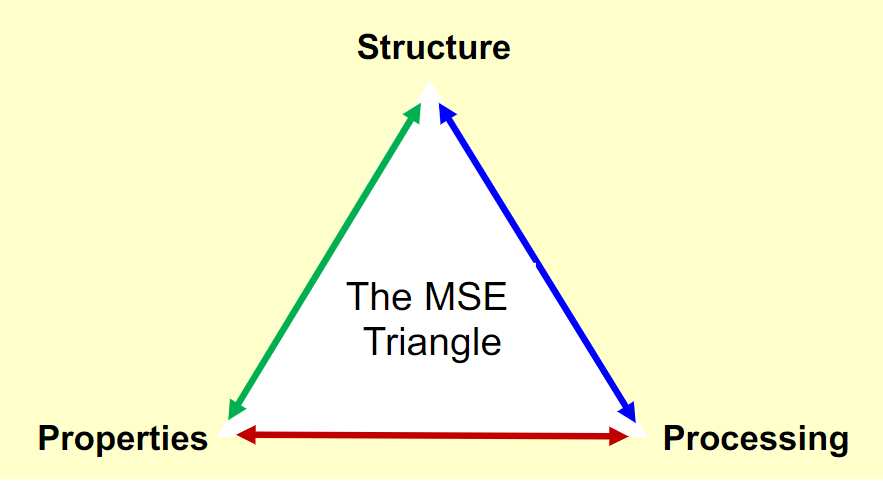
- See slides for more information