Introduction to X-Ray Diffraction (XRD)
- XRD is a technique to study atomic arrangement in crystals
- Non-destructive, used widely in engineering materials
- X-rays have similar wavelength to interatomic spacing
- Applications in Engineering:
- Identifying unknown phases
- Measuring lattice constants and strain
- Confirming unit cell structures (SC, BCC, FCC)
Imperfections in Crystalline Solids
- Real crystals are not perfect
- Contain various types of defects
Point defects (0D): Vacancies, interstitial or substitutional atoms
Linear defects (1D): Dislocations
Planar defects (2D): Internal boundaries
Volume defects (3D): Pores
Dislocations
- Dislocation is a line of misaligned, or dislocated, atoms in a crystal structure
- It is one of the most common types of defects
- Two types: (can be a mix of both)
- Edge dislocation
- Screw dislocation
Edge dislocation:
-
Is when an extra half-plane of atoms is inserted into a crystal structure distorting the surrounding lattice
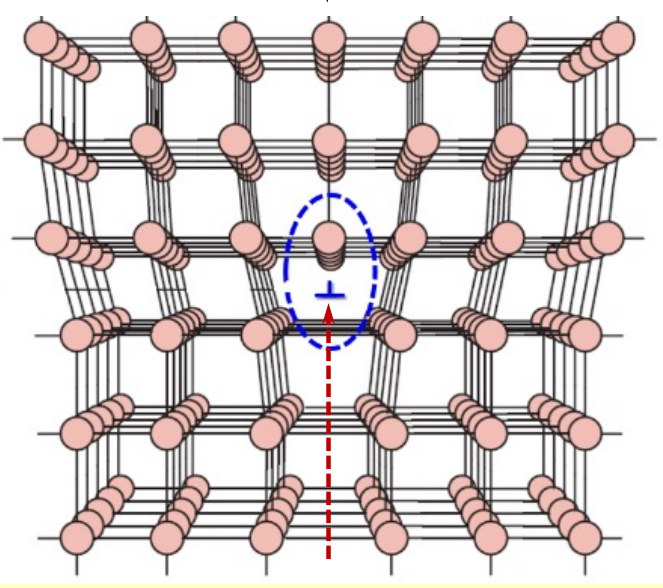
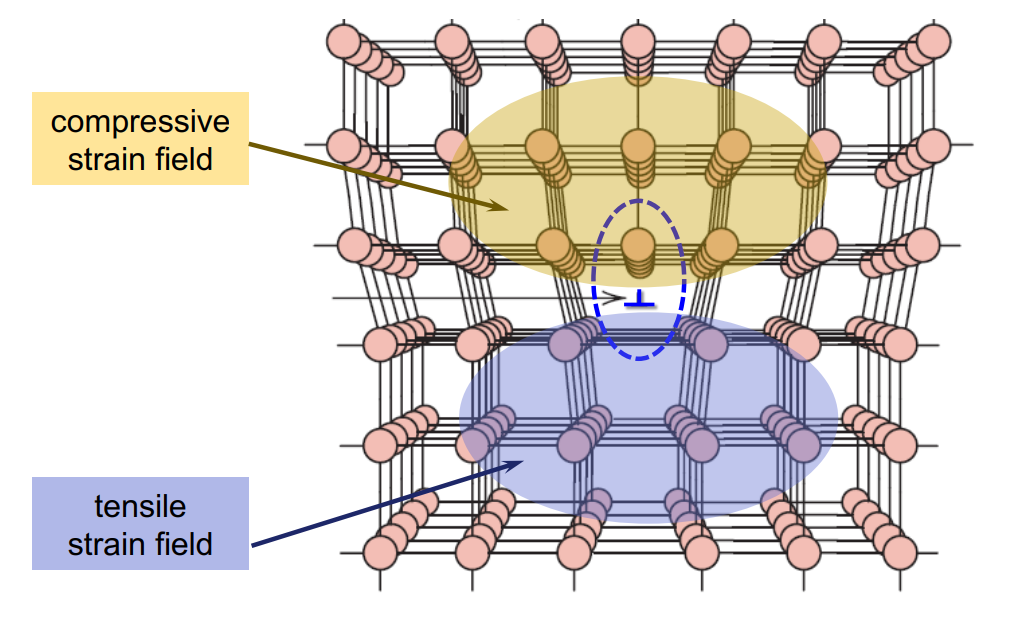
The ┴ is used to illustrate the edge dislocation -
Tensile strain below, compressive strain above
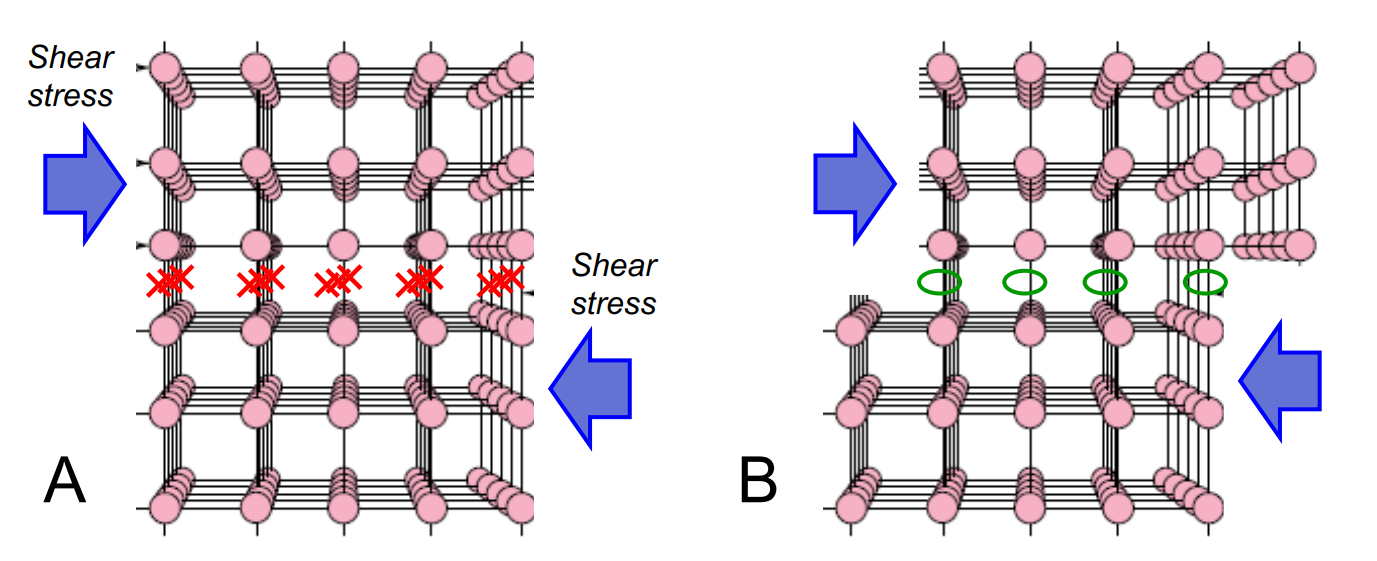
Plane slip:
- When stress is applied to crystal, deforms elastically while stress is low
- When the stress reaches a critical value, plastic deformation occur
- For crystal to plastically deform, interatomic bonds break and re-join to the next line of atoms
- This is very difficult to occur!
- For crystal to plastically deform, interatomic bonds break and re-join to the next line of atoms
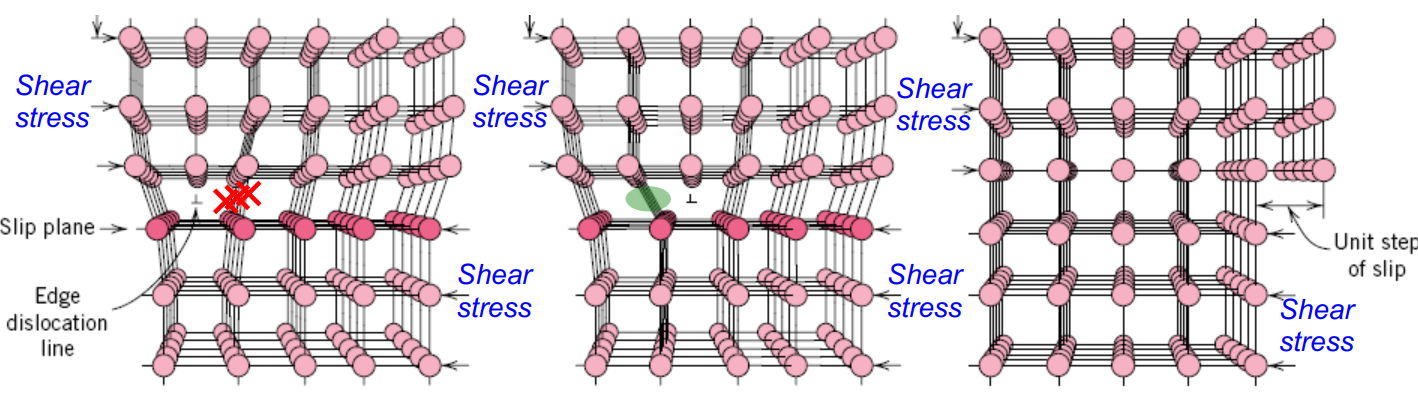
Slip of a crystal can happen in another way, if a dislocation is present
- Under shear stress, only one line of atoms are broken and re-join with the edge of the half-atomic plane of the dislocation
- The same process may repeat by the breaking of the next line of bonds to move the dislocation one step again to the right
Complex Crystalline Structures
- Ceramics are composed of cations and anions that are different in size and opposite in charge
- These properties make ceramics more complex than metals
- Dislocations would cause cations to bond with cation and anions to bond with anions which would have same charges
- This makes dislocations to be nearly impossible
- Thus, ceramics lack the ability to deform plastically