General Plane Motion refers to the complex movement of a rigid body in a 2D plane such that it experiences both a translation and rotation.
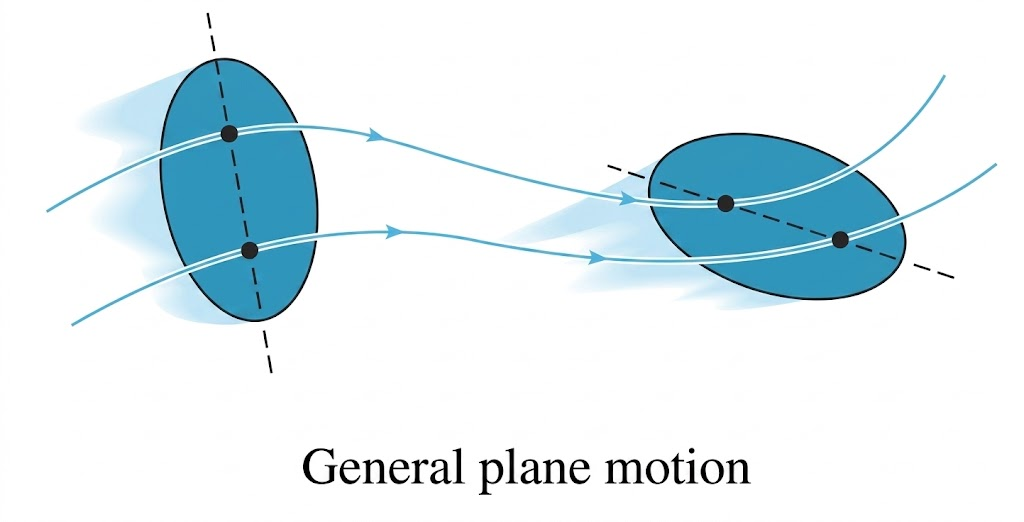
Most everyday objects experience general plane motion, such as a wheel rolling along the ground.
In order to calculate the final position of the object, we deconstruct the motion into its translational and rotational components. We then apply the pure translation, then apply the rotation to get the final position.
Rigid Body Rotation
When particles and are two points on the same rigid body, the distance between them is fixed. Instead, they rotate around each other, changing how we calculate relative velocity and acceleration.
Relative Velocity in Rotation
-
Vector Form (3D/General):
-
Scalar Form (2D/Planar):
Relative Acceleration in Rotation
For calculating relative rotational acceleration, we must consider both tangential acceleration () and normal acceleration () of the rigid body.
-
Vector Form (3D/General):
-
Scalar Form (2D/Planar):
Rolling Without Slipping
When an object (such as a wheel) rolls smoothly across a surface without skidding, it has zero velocity at the point of contact (). This is known as rolling without slipping.
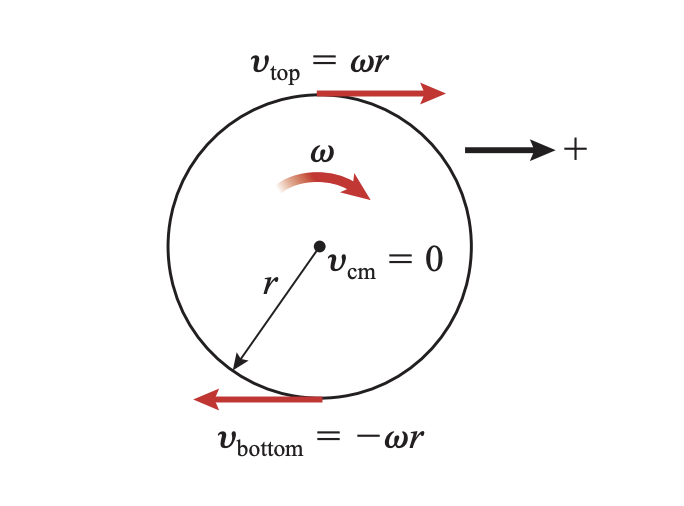
Despite there being no change in speed at , there is rotational velocity (i.e. a change in direction). Thus there is still normal acceleration!
At the centre of the wheel (), there is zero normal acceleration. As the centre moves forward, we are given the tangential acceleration:
The velocity of the wheel is also proportional to how fast it spins:
Moving Reference Frames
Imagine a particle moving atop a rotating rigid body in a 2D plane (e.g. an ant on a spinning fan blade). The rotating body is known as a moving reference frame.
How is the motion of the particle related to a fixed point in space, as well as the moving reference frame underneath?
Absolute Velocity:
- Transport Velocity : The velocity of the point on the rigid body that the particle is passing over at that instant.
- Relative Velocity (): The speed and direction at which the particle is sliding along its path relative to the rigid body.
Absolute Acceleration:
- Base Translation (): The linear acceleration of the rigid body’s reference origin point
- Coriolis (): A correction factor generated because the particle is moving () in a frame that is rotating ()
- Relative Acceleration (): The local acceleration of the particle relative to the rigid body.
const current = dv.current();

if (current && current.file.tags.some(t => t.toLowerCase() === "#topic")) {
    const inlinks = current.file.inlinks;

    // Split backlinks: general notes vs. lecture notes
    const lectureLinks = inlinks.where(l => l.path.includes("/Lecture Notes/"));
    const otherLinks = inlinks.where(l => !l.path.includes("/Lecture Notes/"));

    if (otherLinks.length > 0) {
        dv.header(4, "Links To This Page");
        dv.list(otherLinks);
    }

    if (lectureLinks.length > 0) {
        dv.header(4, "Referenced In Lecture Notes");
        dv.list(lectureLinks);
    }
}