Burn-in screens out chips likely to fail early in their lifecycle by running them under harsher-than-normal conditions. This accelerates latent failure mechanisms associated with manufacturing and assembly defects.
Comment bq
Burn-in is typically reserved for high-value or safety-critical parts because it’s expensive and adds test time.
Stress testing ensures that chips hold up during maximum operational workload. Excessive stress must be avoided as it can damage devices that would otherwise operate correctly.
The Bathtub Curve
The bathtub curve models how the failure rate of a population of similar components may change with operating time.
- Early Life — latent manufacturing defects cause high failure rate
- Useful Life — low, roughly constant failure rate
- Wear-Out — rising failure rate as components age
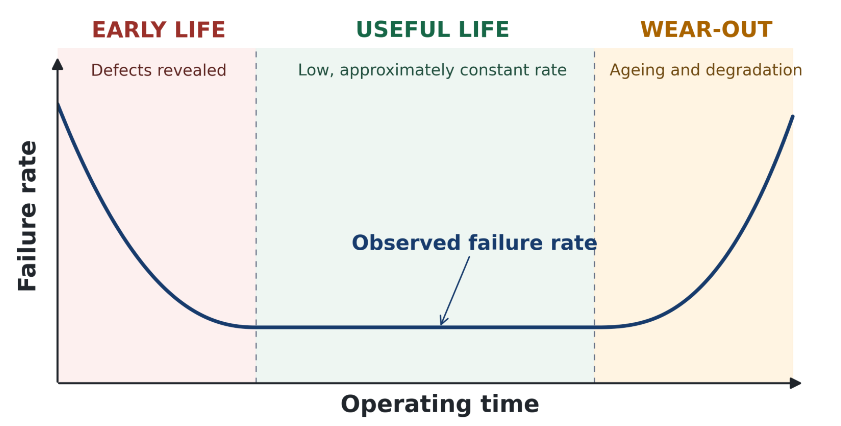
Burn-in prevents consumers from receiving the majority of chips that would fail in early life phase.
await dv.view("Scripts/topic-backlinks");