Dependent motion is a mechanical condition where the motion of one object relies directly on the movement of another.
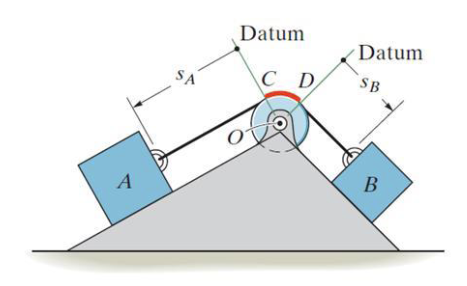
This relationship usually occurs when objects are linked together with cables, pulleys or gears. Due to the geometry of the system, the movement of one object forces the connected part to move in a predictable manner.
To find an equation relating velocities, determine the relation in position coordinates and then derive the expression. You don’t need to consider line segments that don’t change, as they derive to 0 due to being constants.
Full Method:
- Define position coordinates from fixed datum lines, along the path of each particle
- Relate the position coordinates to the cord length
- If a system contains more than one cord, relate position of a point on one cord to a point on another cord
- Separate equations are written for each cord
- Differentiate the position coordinate equation(s) to relate velocities and accelerations
Helpful video:
const current = dv.current();

if (current && current.file.tags.some(t => t.toLowerCase() === "#topic")) {
    const inlinks = current.file.inlinks;

    // Split backlinks: general notes vs. lecture notes
    const lectureLinks = inlinks.where(l => l.path.includes("/Lecture Notes/"));
    const otherLinks = inlinks.where(l => !l.path.includes("/Lecture Notes/"));

    if (otherLinks.length > 0) {
        dv.header(4, "Links To This Page");
        dv.list(otherLinks);
    }

    if (lectureLinks.length > 0) {
        dv.header(4, "Referenced In Lecture Notes");
        dv.list(lectureLinks);
    }
}